Tuesday, February 18, 2020

Iranian hackers targeting Israel!


The new report claims that Iranian hackers have been targeting Israel and other countries with this campaign.

According to the findings of the UK-based cybersecurity firm ClearSky, an Iranian APT group has been running a widespread hacking campaign to compromise VPN servers and install backdoors or bugs to access networks of different organizations across the globe. 
Dubbed Fox Kitten; the campaign was launched three years back (2017) to target “dozens of companies and organizations in Israel around the world,” the company stated in its official statement.
The attackers successfully infiltrated networks of many organizations across diverse sectors from IT, oil and gas, telecom, security, and government. The organizations have footprints throughout the world, which makes this campaign a global scam.
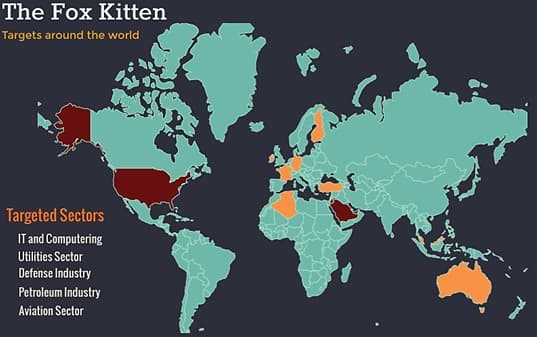
Irani hackers hacked vpn
Image credit: ClearSky
The alarming fact is that during this operation, Iranian hackers not only gained access to the networks of so many organizations around the world but made sure that they were able to hijack the device for as long as they wanted to.
Using the campaign, hackers could develop and maintain access routes to their target companies and obtain sensitive data.
“Hackers maintained a long-lasting foothold at the targeted organizations and breach additional companies through supply-chain attacks,” researchers said in their blog post.
To pull off the attack, hackers used different tools, a majority of which were open-source software while some were self-enveloped. As per previous research, the most successful attack vector that Iranian hackers have used so far is the exploitation of systems vulnerabilities encouraged by unpatched RDP and VPN services.
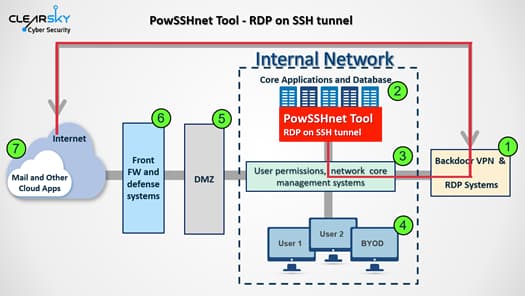
Irani hackers hacked vpn
Image credit: ClearSky
Once they are able to access the organizational networks, they tend to create more access points to reach the core corporate network. This is why closing one access point doesn’t affect their capability of monitoring company networks.
In fact, ClearSky claims that Iranian APT groups can exploit VPN flaws in a few hours, as soon as the bug is disclosed. ZDNet reports that Fortinet, Pulse Secure, Citrix VPNs, and Palo Alto Networks are some of the targets of Iranian hacker groups.

Monday, February 17, 2020


United States on Sunday successfully tested an unarmed life-extended Trident II (D5LE) ballistic missile capable of carrying a nuclear warhead, the US Navy said.

United States on Sunday successfully tested an unarmed life-extended Trident II (D5LE) ballistic missile capable of carrying a nuclear warhead, the US Navy said.
According to the statement, the missile was launched from the Ohio-class ballistic missile submarine USS Maine (SSBN-741) off the coast of San Diego, California.
"Today's scheduled test validated performance expectations of the life-extended Trident II (D5LE) Strategic Weapon System (SWS) and gathered additional data on the SWS' reliability, accuracy, and performance factors. This launch marks 178 successful missile launches of the Trident II (D5 &D5LE) strategic weapon system", the statement said.
The Ground-based Midcourse Defense (GMD) element of the U.S. ballistic missile defense system launches during a flight test from Vandenberg Air Force Base, California, U.SThe Trident II strategic weapon system, originally designed with a life span to 2024, recently underwent a life extension that will keep it operational through the late 2040s, according to the US Navy.
Submarine-launched ballistic missiles Trident II comprise about 70 percent of the US nuclear deterrent, which also includes the US Air Force's intercontinental ballistic missiles and nuclear-capable bombers.

Thursday, February 13, 2020

What is wrong at Facebook????????
Between 1969 and 1971, the US National Reconnaissance Office deployed its state-of-the-art unmanned aerial vehicles over China in a bid to surreptitiously keep a watchful eye on a Beijing's nuclear programme.
In his article for The National Interest, the US magazine’s defence editor David Axe focused on declassified records which documented “[...] termination of the [US] ‘Tagboard’ drone system” which was tasked with spying on China in the late 1960s.
The US National Reconnaissance Office (NRO) released the documents on 21 March, 2019, fifty years after the Tagboard system, also known as the Lockheed-made D-21 unmanned aerial vehicle (UAV), entered service with the US Army.
Axe recalls that the 19-feet-wingspan D-21 was made of titanium and weighed 12 tons [10 tonnes], and that “in its early forms launched from atop a special variant of the A-12 reconnaissance plane, the CIA [Central Intelligence Agency]'s version of the Mach-3 [long-range, high-altitude strategic reconnaissance aircraft] SR-71.”
“The A-12, in essence, was the booster for the drone, climbing to 80,000 feet in altitude and accelerating to Mach 3.3 before separating from the pilotless vehicle”, the author notes.
The hope was that the D-21 would help the US military to spy on strategic targets, including those in China, “more reliably than a satellite could do at the time, and without risking a human pilot”.
There were also experiments with using the airplane to launch the D-21 drone, but these were abandoned when a crewmember was killed on the 4th test flight
pic.twitter.com/G8Bx6Bh3Fg
— Mike Hankins (@Hankinstien) January 26, 2020
"The Tagboard drone provides a unique technical capability to satisfy national requirements to conduct imagery reconnaissance operations against targets hostile or potentially hostile to the United States," the country’s Joint Chiefs of Staff claimed in a September 1969 memo.
Axe recalled that Tagbaord was a “complex and costly system”, with a price tag for two A-12 launch planes and 20 drones amounting to $440 million in 2019 dollars.
“A fatal crash during July 1966 abruptly ended the effort to combine the A-12 and D-21. The NRO added a rocket booster to the D-21 and migrated the system to a small fleet of lightly-modified B-52H bombers”, he noted.
Between 1969 and 1971, the NRO oversaw what it described as four “unsuccessful” D-21 missions over China, including the one on 4 March 4, 1971, when a drone failed to safely eject its film capsule.
“Although the main parachute canopy lowered the payload to the water surface, a subsequent pickup attempt by a Navy vessel was unsuccessful due to procedural errors, and the payload sank”, the NRO reported to the Defence Department at the time.
The D-21 drone on top the M-21, a variant of the A-12. During the fourth flight the D-21 hit the tail of the 21 and both planes and a pilot were lost. #aviation #AvGeek
#history #speed#USAF #CIA pic.twitter.com/ZbIkxhH0ry
— The Shadow of the Eagle (@clemente3000) December 23, 2019
In this context, Axe cited then-NRO director John McLucas as saying in an April 1971 memo that he had “become increasingly convinced” that the US military “should be expending our efforts on upgrading our satellite activities, rather than trying to continue with air-breathing vehicles”.
With the NRO concluding that “unsafe and unreliable drones” were unnecessary for strategic overhead reconnaissance , McLucas predicted the UAVs’ comeback in a different mission in the future.
"I believe that there is a weapons-carrying role for drones which ought to be exploited”, he was cited by Axe as saying.
The author concluded by recalling that a number of surviving D-21s are currently showcased at several US museums, with the wreck of another such UAV now on display in Beijing.

Wednesday, February 12, 2020

The new system is expected to add a fourth layer of air defence in Israel, which often suffers from aerial attacks by its enemies, such as the Hamas movement. Israel currently has separate defence systems to neutralise short-, medium- and long-range missile threats.
Israeli company Rafael Advanced Defence Systems has published a video showing its latest development, the Drone Dome system armed with a laser, in action, downing several unmanned aerial vehicles (UAVs) flying as a swarm. According to Rafael, the system, mounted on an all-road vehicle, is capable of detecting nearby drones, identifying those who are not friendly, and performing a "hard kill" on hostile targets using its powerful laser.

In the video, the Drone Dome first downs a single flying drone and later turns to a swarm of three UAVs downing them one by one. Rafael noted that the system requires just one person to operate properly.
Rafael presented the Drone Dome system for the first time in 2016 , but back then it looked completely different. It was a set of equipment that could be set up in any spot, instead of being mounted on a vehicle. That model also used a "soft kill" method by jamming or interfering with the drone's command signal , forcing it to land or to switch off, instead of burning through it with a laser beam.

Pacific Light Cable Network (PLCN) cable and why it delayed

There's been a lot of press about delayed approval for the
Pacific Light Cable Network (PLCN) cable, which is due to connect Hong Kong, Taiwan, and the Philippines to the United States.
You can understand why this cable has gotten extra attention. Backers include Google, Facebook, and Pacific Light Data Communication (PLDC), which is owned by Chinese ISP Dr. Peng Telecom & Media Group.
While the whole system is awaiting approval from U.S. authorities, Google and Facebook have requested that the FCC allow activation of the Taiwan and Philippines portions of the cable.
There are many regulatory and political issues at play, but I felt a bit of background on the trans-Pacific cable market is warranted amid these headlines.
As you read more about the PLCN, keep these four facts in mind.
Several submarine cables already connect China and the United States
PLCN would not be the first cable to link Hong Kong, or even mainland China, to the U.S. Existing cables include:
Trans Pacific Express (TPE): this cable entered service in 2008
Asia-America Gateway (AAG) : activated in 2009, this cable links many southeast Asian countries to the U.S. with landings in Hong Kong, Guam, Hawaii, and American West Cost.
New Cross Pacific (NCP) : the most recent cable to enter service in the Pacific, this cable connects China, South Korea, Taiwan, and Japan to the U.S.
Direct cables are not the only way data can travel between China and the United States
While cables that offer a direct path between countries is preferable in many cases, data can traverse any number of cables en route to its final destination.
Even though there several cables that link China and the United States directly, there's certainly a substantial amount of traffic that travels on an intra-Asian cables, like the Southeast Asia-Japan Cable or Asia Pacific Gateway, from China to Japan.
In Japan, this traffic can transfer to a trans-Pacific cable, such as FASTER or Unity , to reach the U.S.
PLCN is not the only planned cable between Hong Kong and the United States
PLCN is just one of several planned submarine cables that intend to link Hong Kong to the United States (or U.S. territories). These include:
Hong Kong-Americas (HKA) : this consortium cable involves several parties including Facebook, China Telecom, and China Unicom.
Hong Kong-Guam: Google is an investor in this cable alongside RTI
Bay to Bay Express (BtoBE) : this system is backed by Facebook, Amazon, and China Mobile
Content providers are investing in many new cables
Google and Facebook’s involvement in PLCN is one of many investments made by these two companies. And other content providers are following suit.